
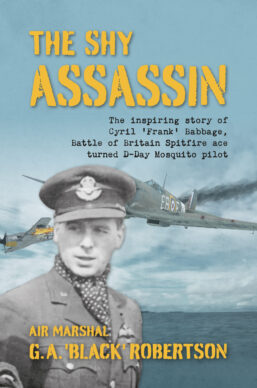
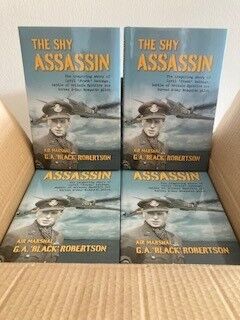
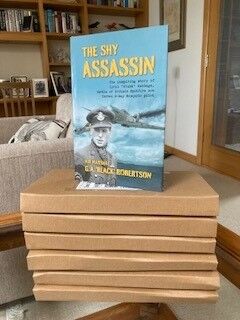
Among the most valuable contributions to Second World War aviation literature are those that recover lives which might otherwise have slipped away: the careful resurrection of men who served with distinction but left little trace. The Shy Assassin – Air Marshal G.A. ‘Black’ Robertson’s stirring account of Spitfire ace and Mosquito pilot Cyril ‘Frank’ Babbage – is emphatically that kind of book, and a highly welcome addition to the genre.
Babbage began the war as a quiet, undemonstrative young man from Ludlow, having previously signed up for the RAF Volunteer Reserve (RAFVR) in October 1938 at the age of twenty-one. It is worth pausing here to appreciate what that act of enlistment represented. Nearly 800 pilots who fought in the Battle of Britain had used the RAFVR as their ‘portal of entry’ to the service, constituting over a quarter of ‘the Few’ who took part in that iconic campaign.
The introduction of the RAFVR, as Robertson explains, “created a unique dynamic: crews comprising airmen, NCOs and officers”. Typically, both RAFVR pilots and non-commissioned officers who flew in the Battle of Britain have received less historical scrutiny. Before long, however, the young sergeant was flying alongside – and frequently outperforming – men of higher formal rank as part of No. 602 Squadron.
That Robertson restores Babbage to proper visibility within that context is one of the book’s more subtle yet important achievements. The author expresses the full scale of what lay ahead for ‘Cabbage’, as he was known in the service: “With no experience on type, and little in overall terms (180 hours total, just 130 solo), he found himself posted to a Spitfire squadron. It’s difficult to imagine a greater challenge for an embryo fighter pilot than on-the-job training in time of war”.
Robertson frames much of the narrative through squadron Operations Record Books (ORBs), showing the air war as it truly was: punctuated not only by frenetic combat, but also long stretches of routine patrols. When Babbage is posted to No. 41 Squadron on 12 June 1941, for instance, the Blitz has ended and the Luftwaffe’s tempo has slowed; he flies just three operational sorties during the rest of that month. It would have been tempting to compress such periods into transition, yet Robertson resists doing so, giving them their proper weight.
The ORBs, however, are only part of his archival range. Nearly fifty years after Babbage was shot down on 26 August 1940, an eyewitness account surfaced in remarkable fashion. A postcard collector wrote to the West Sussex Gazette asking for further information on one of the cards purchased at a local fair, which showed “Sgt Cyril F. Babbage returning to shore”. The paper later published a feature which evocatively described the scene:
“He pitched in the sea about half a mile offshore, where he was picked up by some fishermen. He was brought ashore with cheers ringing in his ears from several hundred persons who flocked to the sea-shore, although the all-clear had not sounded, thus incidentally, exposing themselves to extreme danger.”
That Robertson tracks down material of this kind — fragmentary, accidental, decades removed — speaks to the depth of his research and his instinct for the telling detail. He does not just rely on the reporting of others to inject jeopardy and drama into his writing, however. Robertson’s prose on what later became known as the ‘Hardest Day’ (18 August 1940) brings the action vividly to life: the Stuka sideslipping to frustrate Babbage’s aim, the rear gunner silenced, the prey sent crashing into the sea.
Babbage’s own combat report, placed among several others in the appendices, naturally offers a more clipped and unadorned account: “I attacked one Ju 87 when making out to sea, part of a general stream. This did skids to escape, but I opened fire silencing rear gunner. I attacked again firing another long burst, enemy aircraft dived into the sea”. The cool determination beneath the service language is a direct glimpse of a man disinclined by temperament to be caught out.
In a book documenting the life of such a self-effacing individual, one wonders if weaving these ten combat reports directly into the chapters might have allowed Babbage’s calm voice to emerge more fully in the book — though this remains a stylistic preference rather than a fundamental shortcoming. Given the commercial pressures surrounding historical publishing, this editorial decision to prioritise gripping narration over factual reports is understandable.
When an author writes for a mainstream audience, certain compromises with editors and publishers are inevitable. For instance, the inside flap perhaps overpromises to shed light on Babbage’s personal connection to the pioneering aviatrix Amy Johnson. It claims she is part of a “fascinating cast of supporting characters [that] adds colour to his experiences”, yet the book itself is seemingly confined to her attending No. 602 Squadron’s New Year’s Eve party shortly before her tragic death in January 1941.
Robertson honestly ponders in the epilogue, “But what impression did Amy Johnson make on him? She certainly captivated his colleagues”, before concluding that “we will never know”. No direct interaction between Johnson and Babbage, then, appears to have been recorded. However, this likely reflects the archival difficulty of reconstructing the interior lives of quiet men rather than any failing on the author’s part. Moreover, this book sparkles enough without needing to shoehorn famous names within aviation history to secure wider appeal.
As Babbage’s war evolves — from the reactive scrambles of 1940 into the longer-range offensive operations that characterised the middle and later years — Robertson charts the transition with sure-footed pacing. The Mosquito chapters carry their own steadfast authority, covering the nighttime interdiction sorties with 464 Squadron Royal Australian Air Force (RAAF) that took Babbage over occupied France in order to pave the way for the Normandy campaign.
Eventually, the squadron’s first penetration into Nazi Germany itself comes on 31 August 1944, when Babbage and his navigator, Flying Officer N. E. McIntyre, were among fifteen crews who bombed railway targets in the Saarbrücken area. It was, Robertson notes, Babbage’s busiest month yet on operations: nearly thirty-six hours in the air. The Mosquito, with its extraordinary range, speed and versatility, placed Babbage in an entirely different kind of war from the furious defensive fighting of 1940, and Robertson does justice to both.
The book later documents Babbage’s post-war RAF career, most notably serving as an instructor on early fast jets such as the Gloster Meteor and the de Havilland Vampire. No matter his posting, as Robertson soberly reminds us, the common thread running through the book is “human frailty — the very impermanence of life”. This is illustrated by the tragic statistic given of 450 Meteor pilots killed during the aircraft’s time in RAF service; despite his wealth of flying experience and skill, Babbage could so easily have been one of them.
The Shy Assassin is a touching, meticulously researched and deeply human work. In his foreword to the book, Air Chief Marshal Sir Michael Graydon frames the work with wider urgency: “especially now when the free world is confronting a level of instability and threat not seen since the 1930s, both the media and the public could gain much from a better understanding of what a major war entails”. Robertson’s rich and assured prose answers that call with considerable distinction.
Book Review by Dr Victoria Taylor (BA (Hons), MRes, AFHEA)




No comments yet.